I
THE NINTH VIDEO
On 15 February 2024, OpenAI launched its text-to-video AI model Sora. In the list of generated examples, the ninth video titled Prompt: A young man at his 20s is sitting on a piece of cloud in the sky, reading a book. depicts a man holding a book with its pages flipping in the wind amidst clouds.
At around the 5-second and 13-second marks, pages from the book can be observed to flip in a perpendicular direction against the spine of the book, as if bound to the bottom fore-edge rather than the spinal side of the book. This construction is convoluted, if not impossible, since binding more than one edge of the book renders it unopenable in our three-dimensional experience. It was a hallucination of a book.
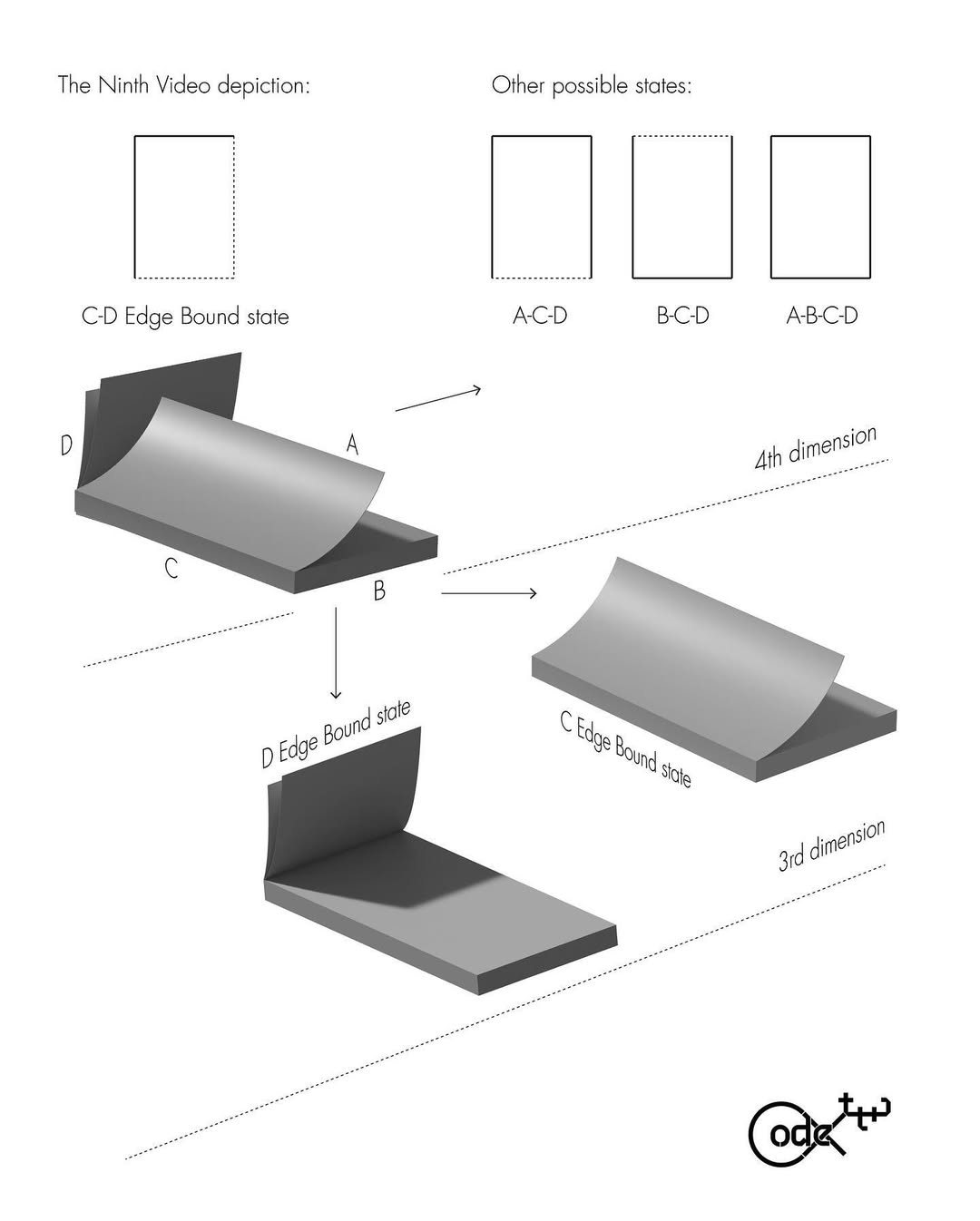
In “A Primer of Higher Space” (1913), Claude Bragdon illustrates the fourth-dimensional hypercube (tesseract) as an extension of the familiar 3D cube, with each of its faces also being a cube. By extension, we can imagine a fourth-dimensional book-object by the analogy of a third-dimensional book, but with a twist: the fore-edges (or all edges) of each page are also gutters/spines of the book itself or, of other books. Here, the fourth-dimensional codex is an endless cascade of interconnected volumes, ad infinitum.
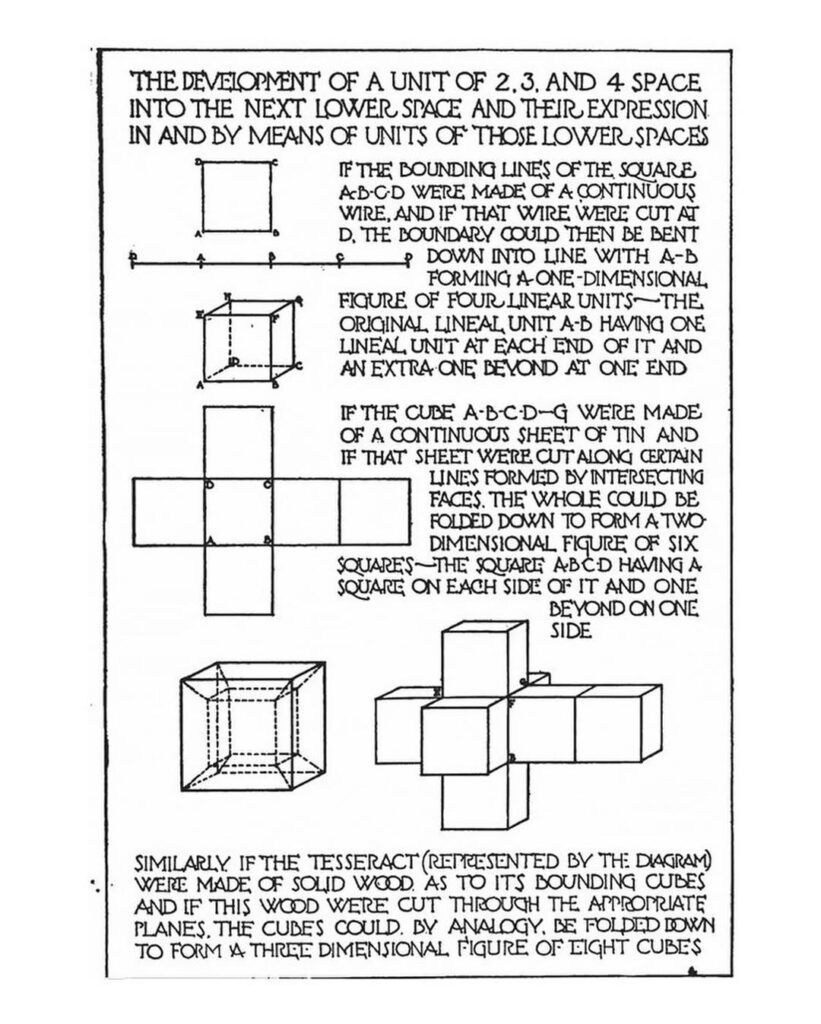
Claude Bragdon, A Primer of Higher Space (1913)The book-object depicted in the ninth Sora video fits one iteration of this description: a dual-edge bound, unopenable book opened by OpenAI from the latent dimension. By hallucination or analogy, it is a depiction of a four-dimensional book.
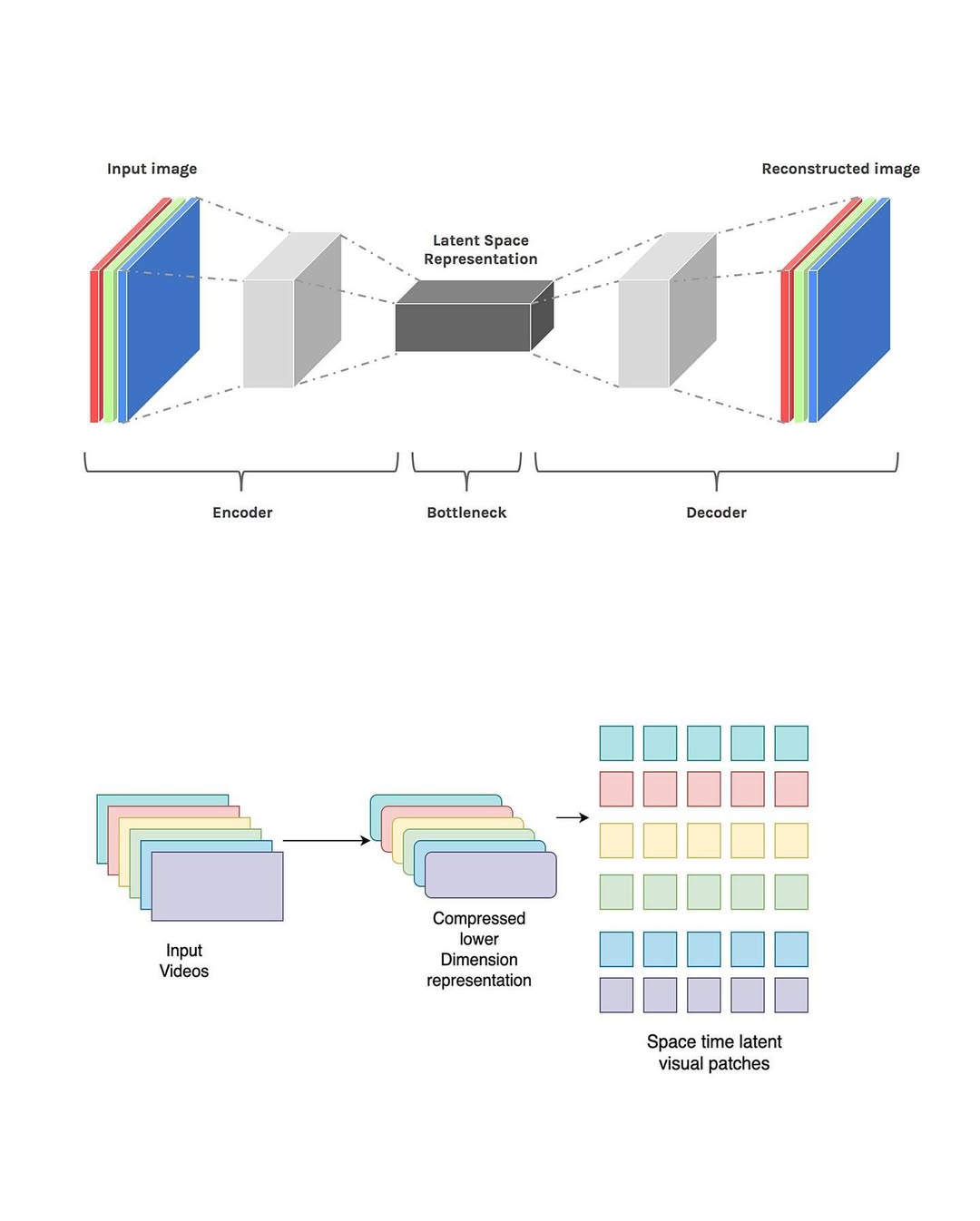
Sora operates on a transformer architecture; video/image emergent from the latent space: a “lower-dimensional” space where higher—dimensional data are compressed and mapped to be processed. This abstract space is instrumental in machine learning processes to manage data points, allowing for reconstruction back into the “higher dimension” as generated output.II
BLACK HOL(OGRAPHY)
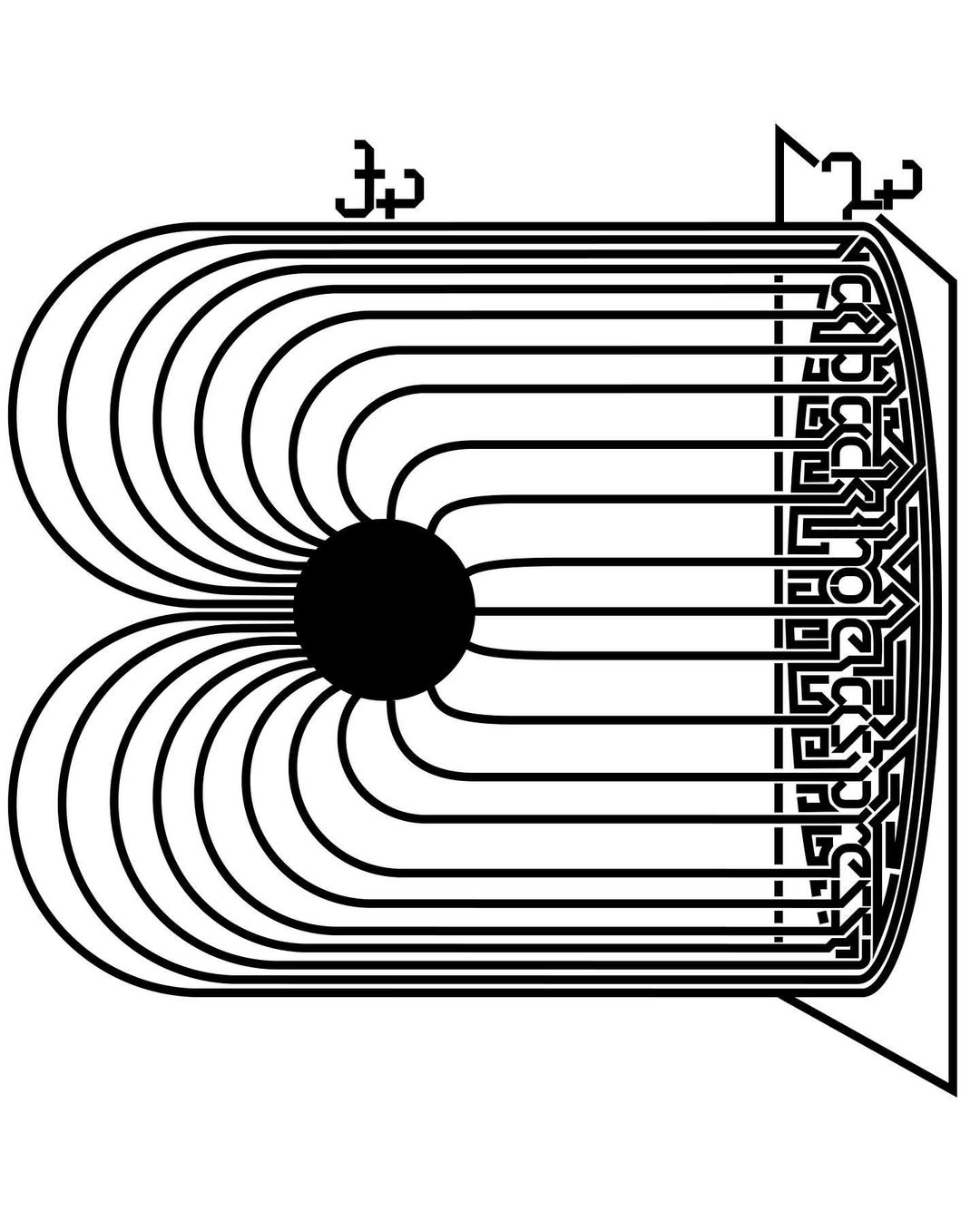
The wordholography comes from the Greek words holos and graphē, loosely translating to “whole” and “picture” respectively.
In print terminology, the familiar security “3D” foil prints are described as having optical ‘holographic’ properties—apparent ‘3D’ objects within a flat “2D” surface. A whole picture imprinted/encoded on a surface. Holograms in our three-dimensional (spatial) experiences can therefore be described as 3D ‘information’ of a volume equivalently stored on the surface/boundary.
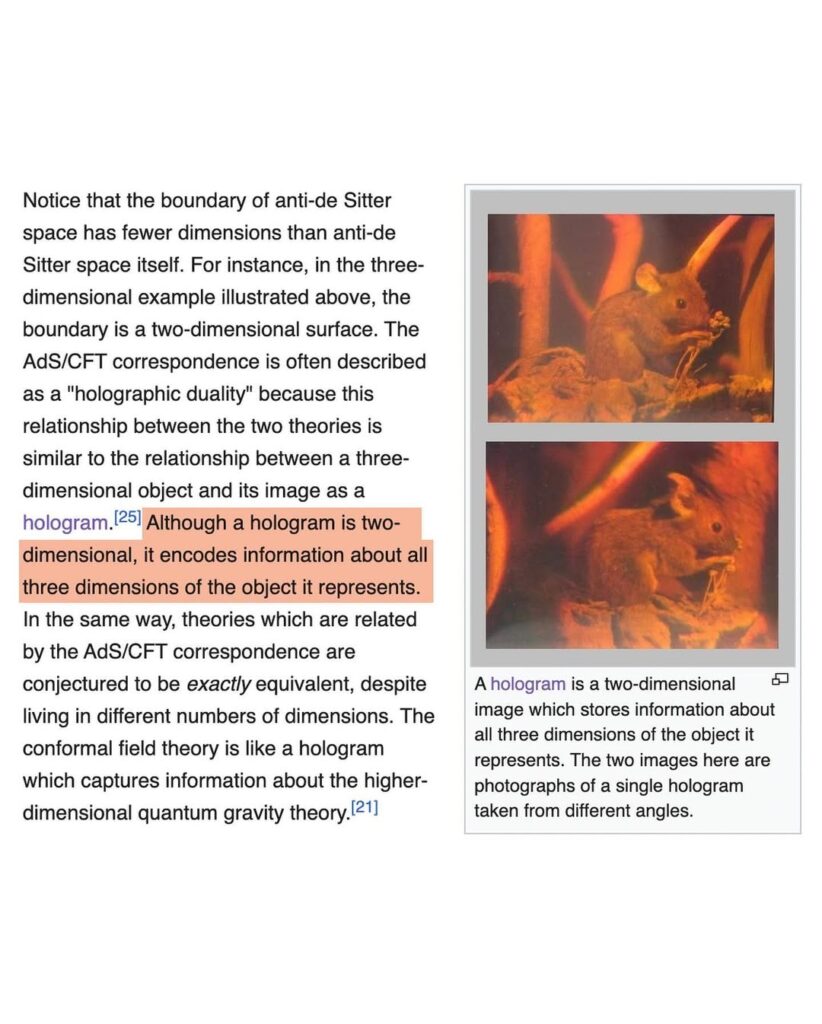
Holography" Wikipedia
In theoretical physics, the holographic principle posits that our three-dimensional lived experience is a hologram, as physicist Leonard Susskind describes: “the universe … is a hologram, an image of reality coded on a distant two-dimensional surface.” First proposed by Gerard ‘t Hooft, the principle was inspired by black hole thermodynamics, which posits that maximum entropy (by extension, information storage) scales with the radius squared, not cubed as expected. This notion is akin to a 3D container’s storage limit determined by its surface area instead of its volume. When extrapolated universally, this principle unintuitively suggests a certain base reality that is lower-dimensional; a 2D hologram of a 3D world. A whole universe imprinted on a surface.
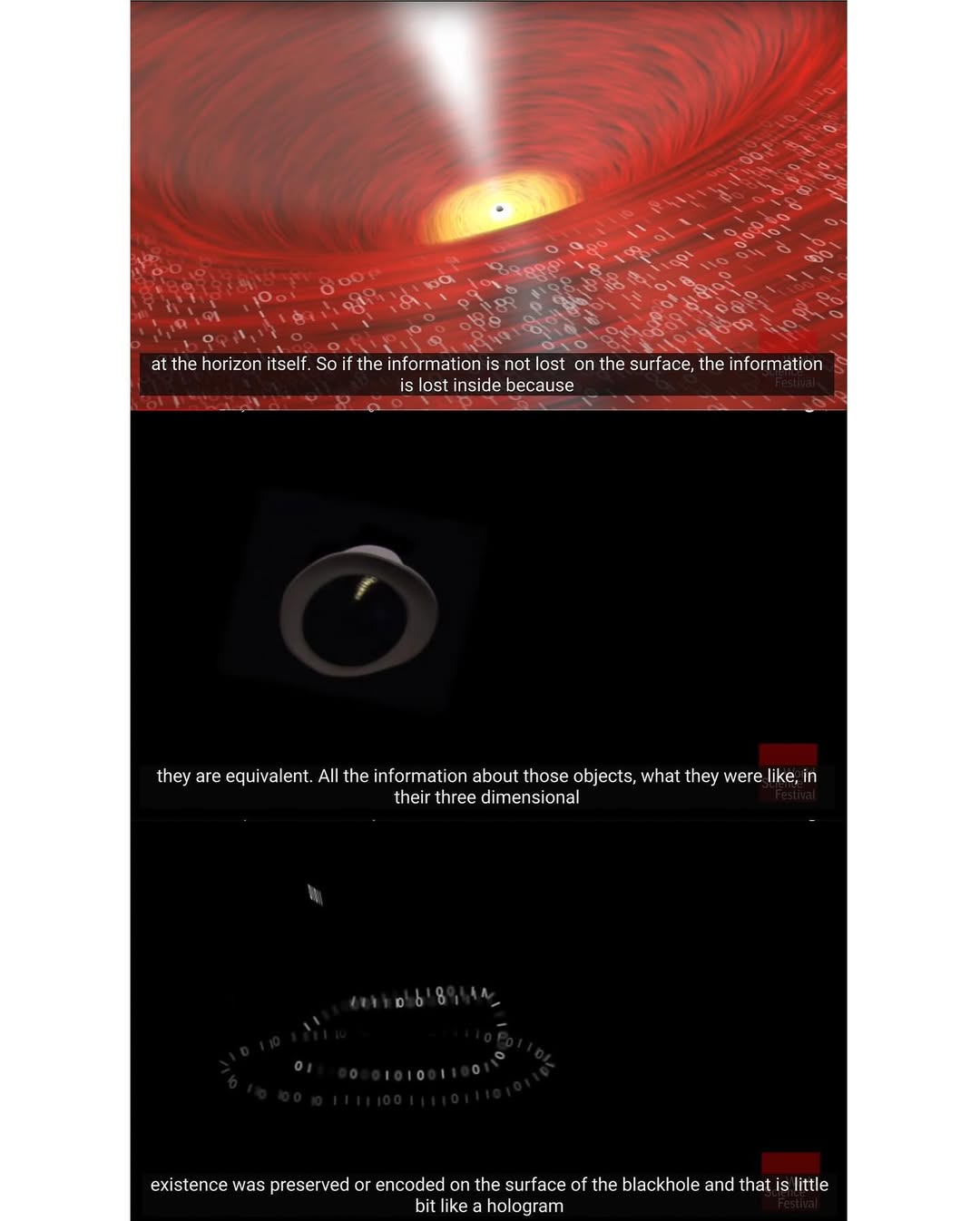
“
What is the Holographic Principle?" World Science Festival on YouTube.Due to mechanics surrounding black holes, material falling past the event horizon becomes information trapped/imprinted on its surface/boundary. The idea of ‘imprinting information onto a surface’ intrinsically describes a printing event/press. The black hole does not pull; what eventualises on its surface is a press.By analogy, a 4D (spatial) codex can be wholly projected by a 3D hologram. This analytically describes a volumetric 3D book-object as a “surface” of which 4D information is imprinted. This 4D description of a book (3D hologram) remains elusive in our lived experiences. Here, the fourth-dimensional book is an object from a higher dimension that can only be conjured via description, by way of analogy—information. It can never materialise.
All we are left with are words, like prompts we feed to generate what we can never hold.
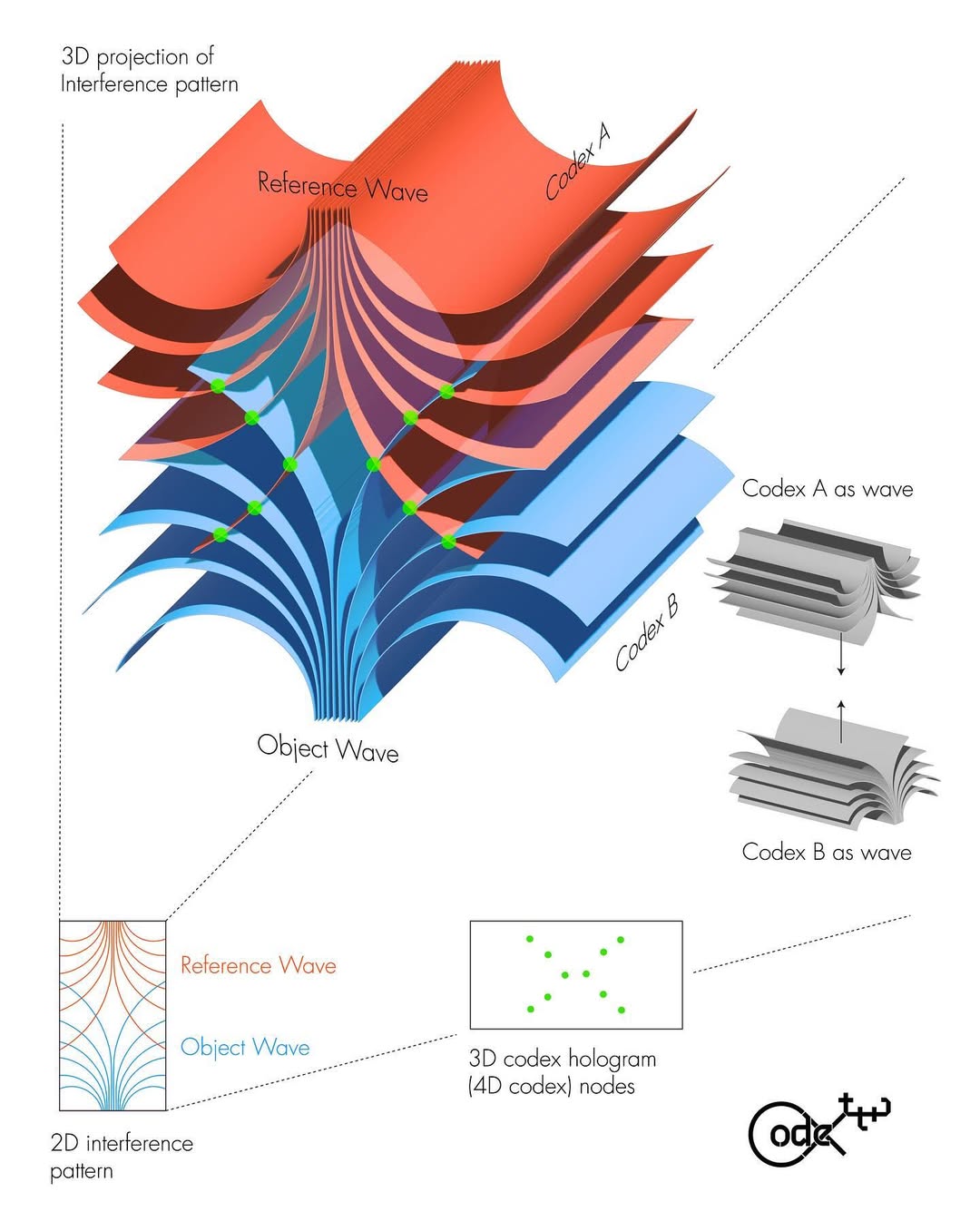
Artist illustrations of 4D codex captured via interferometryIII
A BOOK REMEMBERS
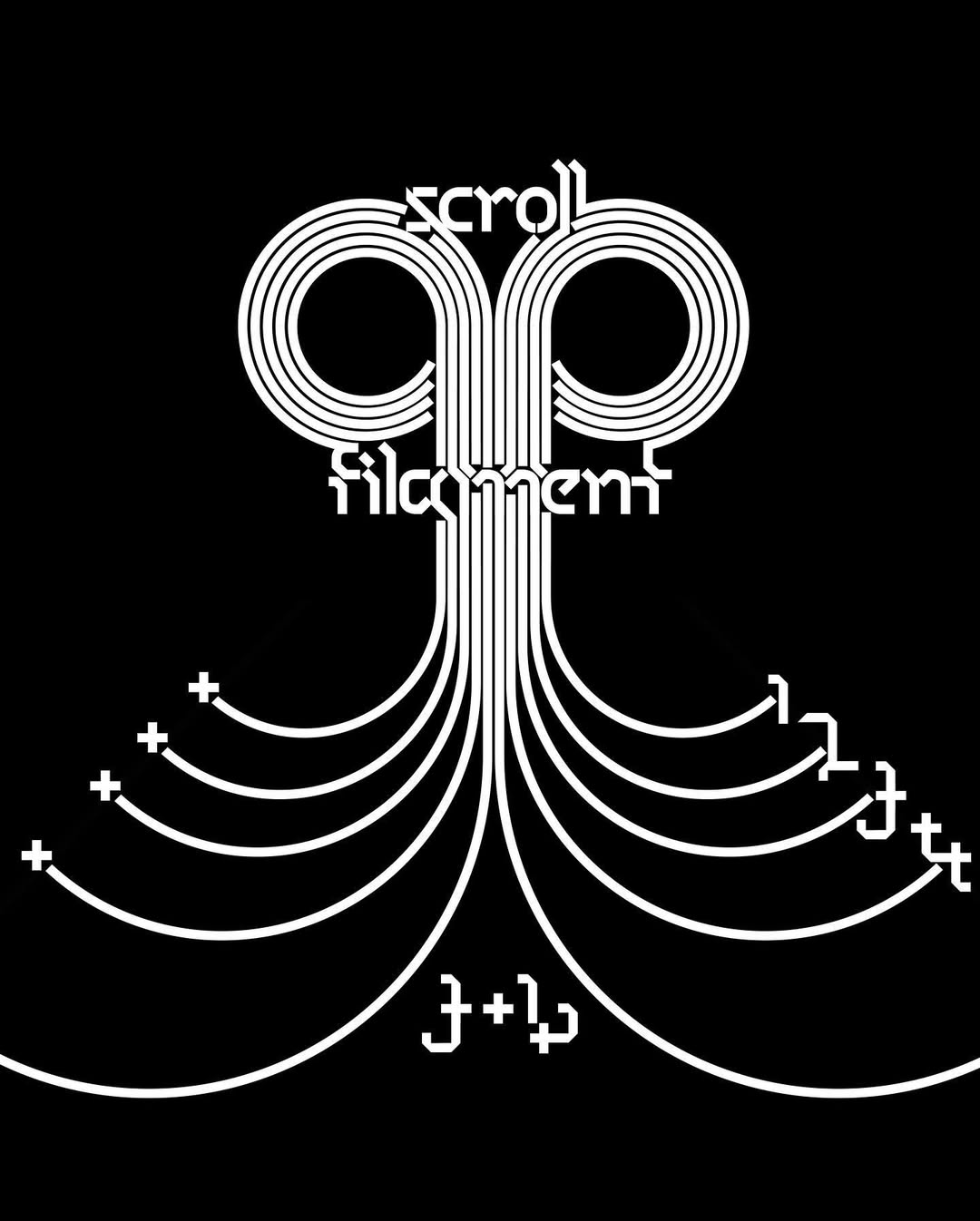
4D printing is an extension of the 3D printing method (coined by Skylar Tibbits, MIT Self-Assembly Lab), a nascent technology framing “4D” (3+1D spacetime) under Einstein’s general relativity’s articulation of time as the 4th dimension.
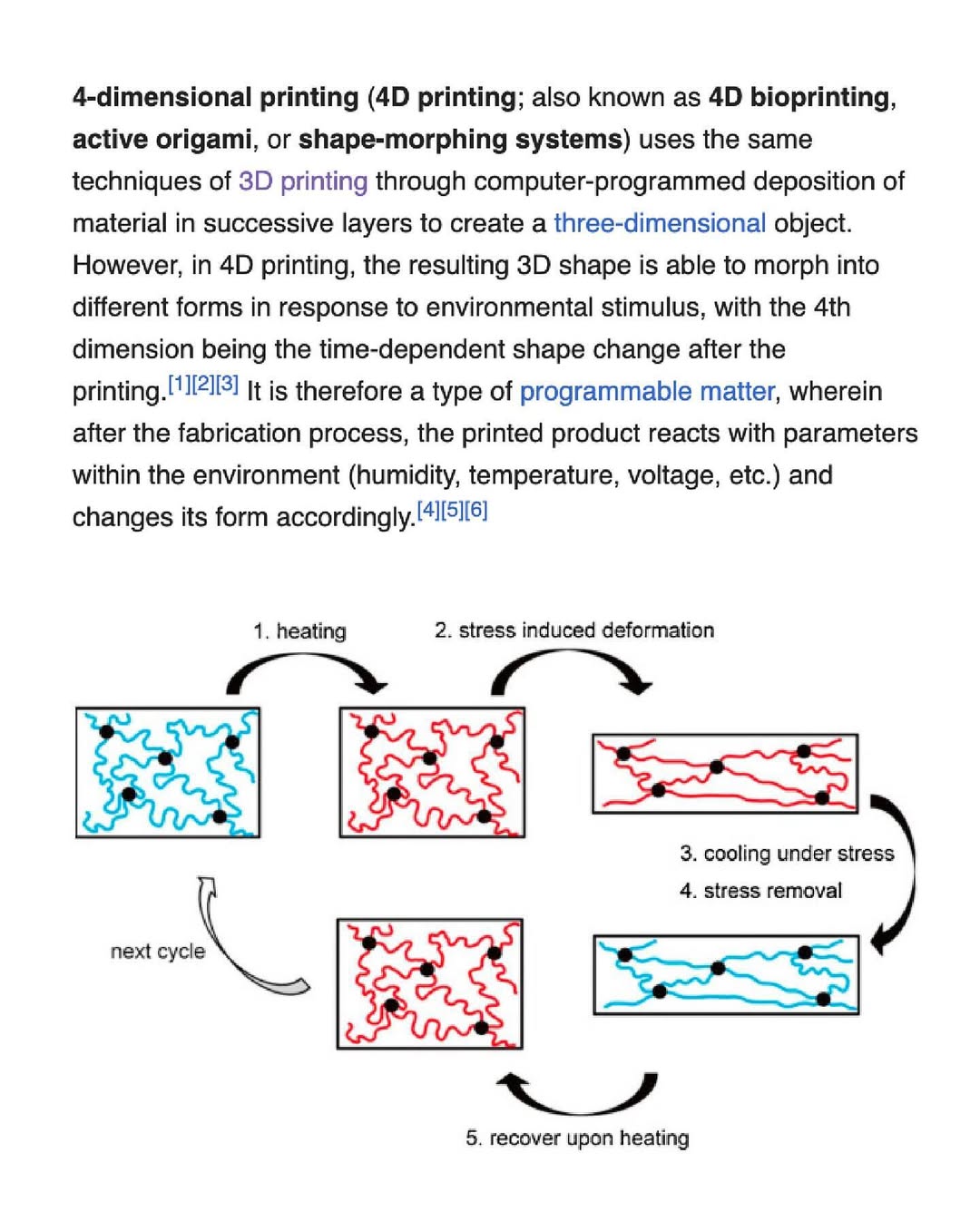
An umbrella (misnomer) term for time-dependent 3D printed objects that can morph or change properties (both ways) over time, “4D printed” objects are “activated” by external stimuli like heat and light. Through material science, clever engineering, and special filaments like Shape-Memory Polymer (SMP), objects 3D printed with these materials imbue the temporal aspect into the object—materialising an intended, mechanical “future state” after it leaves the printer. This ‘memory’ is the persistence of molecular³ bonds that endures deformation.
The notion of a 4D book is inextricably linked to 4D printing. SMP personifies the object with terms like “intelligent” and “memory” to describe the material, suggesting that objects “remember” their past. What might a (3D printed) book remember?
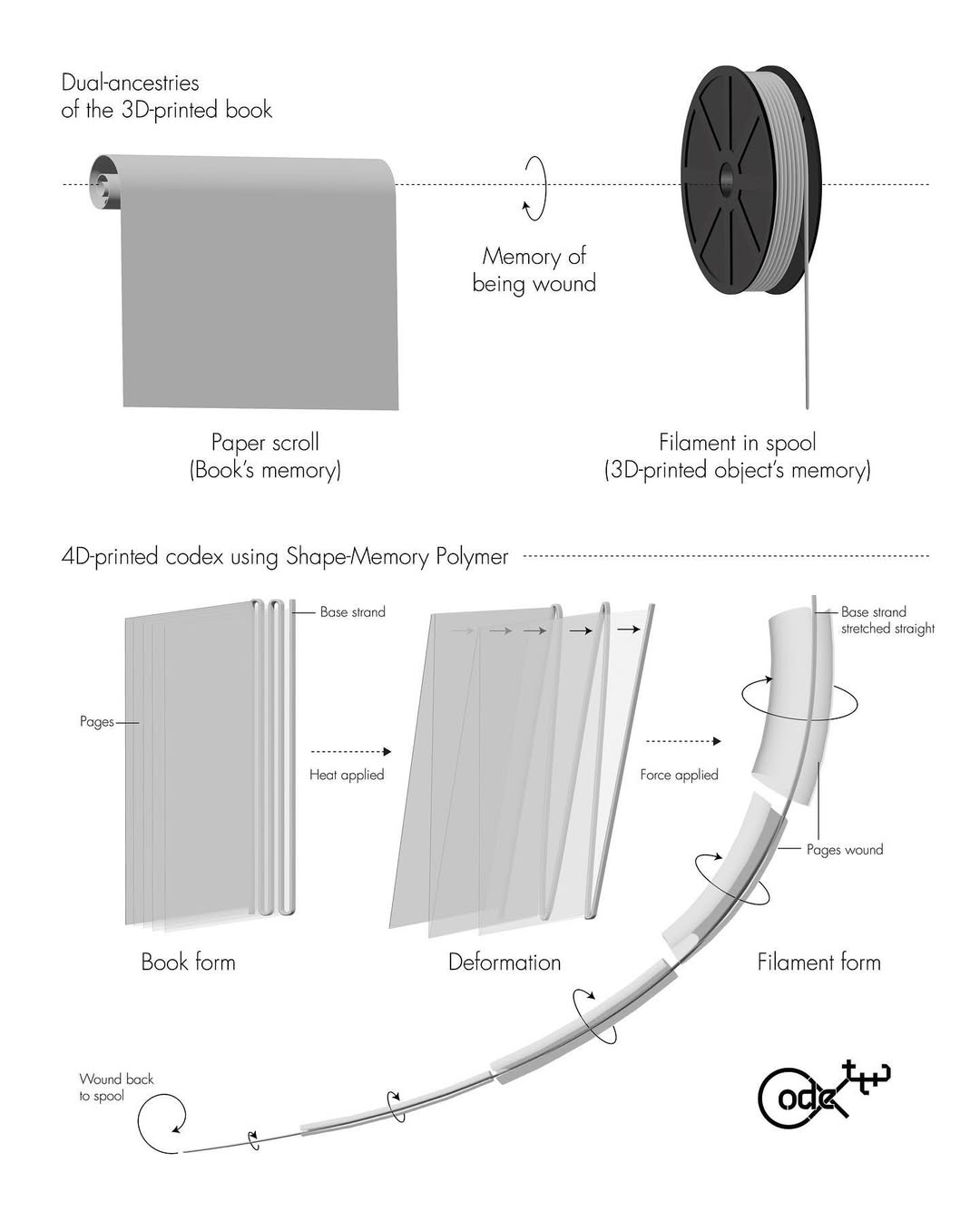
The 3D printed book (codex) remembers its dual-ancestries. Winding back time, the 3D printed book remembers being wound: materially, as plastic filament in a spool; historically, as papyrus/paper wound/rolled as scrolls.
The SMP-3D printed book initially printed in book form. At this point, the book forms memories molecularly.The SMP-3D printed book wound into a filament form from its book form with heat.The SMP-3D printed book (in a filament-form), returning to its previous form as a book.The 4D codex is bound at the spine, but not by time. It is bound with time, simultaneously remembering its past and its future. Here, the fourth-dimensional codex is printed with memories of a future form, but can also return to a previous state in the past.
The 4D book remembers. From the element it became, to the filament it returns.
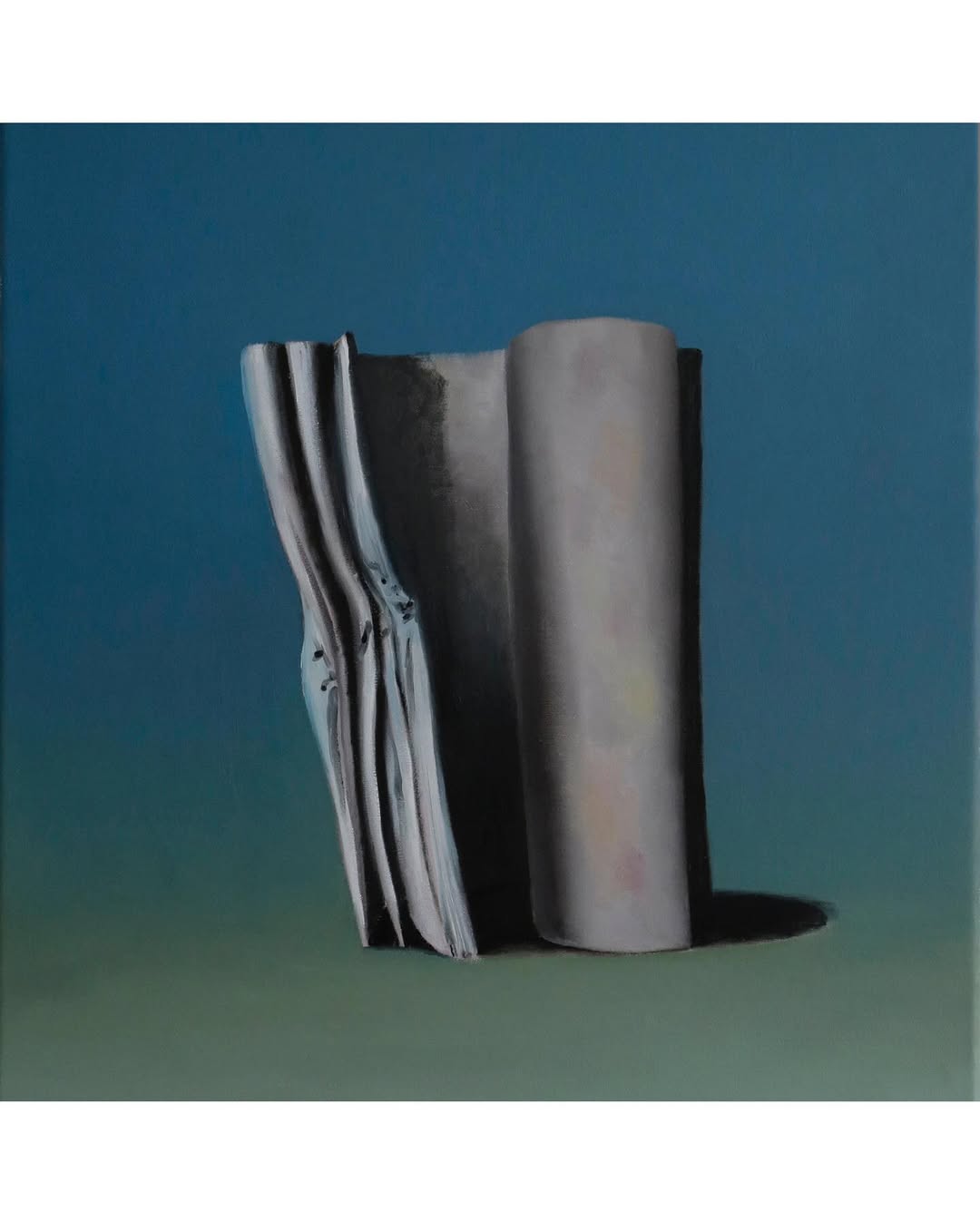
‘beaten frowns after’ 2016, Ivan Seal. Cover art for The Caretaker’s Everywhere at the End of Time, a music series about memories. It is to note that this painting similarly depicts a book-object, perhaps deformed by time.